
LASIK vs PRK: Which Laser Eye Surgery Suits You, and Where SMILE Fits
How LASIK, PRK and SMILE differ, who suits each (thin corneas, dry eyes, contact sports), how recovery compares, and how long to stay in Tabriz.
تیمی نووسەرانی تەبریز هێڵس

LASIK vs PRK is not a question of an old method against a new one. Both use the same kind of laser to reshape the cornea, the clear front window of the eye. The difference is how the surgeon reaches the tissue, and that changes who suits each method, how the first week feels and how long you should stay in Tabriz.
This guide compares the two, adds SMILE as a third option, and explains the tests that decide between them. Tabriz Health is a facilitation platform, not a clinic: coordinators can help you contact licensed eye centers in Tabriz, compare written quotes and plan the trip. The choice of technique belongs to the eye surgeon who examines you.
- LASIK and PRK both reshape the cornea with a laser; LASIK works under a thin flap, PRK works on the surface with no flap.
- A Cochrane review of randomised trials found LASIK gives faster visual recovery and less pain, while results one year after surgery were comparable.
- PRK is often suggested for thinner corneas, for people with dry eyes, and for people who play contact sports or have physically active jobs.
- SMILE is a third option that removes a small piece of tissue through a tiny incision, without a flap.
- PRK usually needs a longer stay, because the bandage lens is often removed at a check-up about a week later.
How LASIK works
LASIK is done with numbing eye drops, as an outpatient procedure. The surgeon first creates a thin flap on the cornea, either with a femtosecond laser or with a mechanical blade called a microkeratome. The flap is lifted, an excimer laser reshapes the tissue underneath, and the flap is laid back in place, where it stays without stitches.
Because the surface is left largely intact, many people see well the day after LASIK. The trade-off is the flap: it can, rarely, be dislodged by a blow to the eye, and it uses up some of the corneal thickness.
How PRK works
PRK (photorefractive keratectomy) uses the same type of laser, but there is no flap. The surgeon removes the thin outer layer of the cornea (epithelium) using a brush, a blade, a laser or an alcohol solution, then the laser reshapes the surface directly. LASEK is a closely related surface method. A bandage contact lens is placed on the eye to protect it while the outer layer grows back, which takes about a week.
The difference is felt afterwards. According to the American Academy of Ophthalmology, eye pain after PRK typically lasts two to three days, vision improves over three to five days, and the best vision may take a month or longer.
SMILE: a third laser option
SMILE (small incision lenticule extraction) uses a femtosecond laser to shape a thin, lens-shaped piece of tissue inside the cornea. The surgeon removes it through a small incision of about 2 to 3 mm, so there is no flap and no removal of the outer layer. It is mainly used for short-sightedness, with or without astigmatism.
Studies report that SMILE and LASIK give broadly similar results, and some report fewer dry-eye symptoms after SMILE. If a further treatment is needed after SMILE, it may need to be done with PRK. Ask whether a center offers it and whether it suits your prescription.
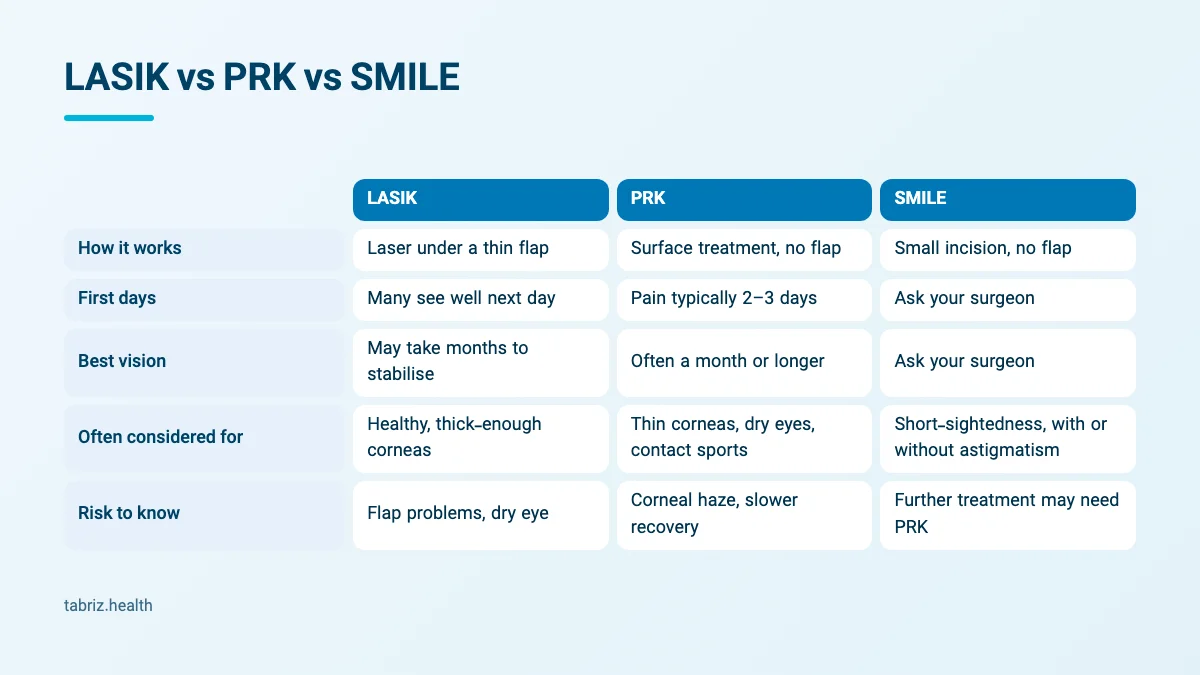
LASIK vs PRK vs SMILE at a glance
| LASIK | PRK | SMILE | |
|---|---|---|---|
| How the cornea is treated | Under a thin flap | On the surface, no flap | Tissue removed through a small incision |
| First days | Many see well the next day | Pain typically 2–3 days; bandage lens for about a week | No flap and no surface wound; ask your surgeon what to expect |
| Best vision | May take months to stabilise | Often a month or longer | Ask your surgeon for your case |
| Often considered for | Healthy corneas of adequate thickness | Thinner corneas, dry eyes, contact sports | Short-sightedness with or without astigmatism |
| Specific risk to know | Flap problems; dry eye | Corneal haze; slower recovery | Further treatment may need PRK |
Which is better, PRK or LASIK?
Neither is better for everyone. A Cochrane review pooled 13 randomised trials covering 1,923 eyes. It found that LASIK gives faster visual recovery and is less painful, while results one year after surgery were comparable. The reviewers rated the evidence as low quality for most outcomes and said more trials with current techniques are needed to confirm whether the two are equally safe.
The American Academy of Ophthalmology reports that about 90% of people reach 20/40 vision or better without glasses or contacts after PRK, and Cleveland Clinic cites the same rate for LASIK. In practice, your corneas and lifestyle decide.
When PRK may be the safer choice
- Thin corneas. LASIK is usually not recommended when the cornea is thin, because the flap uses up part of the thickness.
- Dry eyes. Existing dry eye may rule out LASIK. Cleveland Clinic notes that, after the first healing, PRK patients are less likely to need artificial tears than LASIK patients.
- Contact sports or active jobs. With no flap, there is nothing to dislodge if the eye is hit. Martial arts, wrestling and similar sports are typical examples.
When LASIK may suit you better
If your corneas are healthy and thick enough and your eyes are not dry, LASIK's faster, more comfortable recovery is the main advantage, which matters when you have limited days away from home.
Who is not suitable for either
Laser correction is generally for adults whose prescription has not changed in the past year. It may be postponed or advised against if you are pregnant or breastfeeding, if your prescription is still changing, or if you have keratoconus (a thinning and bulging of the cornea), advanced glaucoma, a cataract affecting vision, uncontrolled diabetes, corneal scarring or disease, or certain autoimmune conditions. Very large pupils can also count against LASIK. When the cornea is not suitable for any laser method, a lens-based option may be discussed; our LASIK treatment guide explains those alternatives and how the whole trip is organised.
None of these methods prevents age-related loss of near focus; most people need reading glasses as they get older.
The tests that decide between LASIK, PRK and SMILE
The eye assessment in Tabriz turns a preference into a plan. It usually includes corneal thickness and shape (topography), your prescription, pupil size and the health of the tear film and the rest of the eye. Tell the doctor about every medicine you take.
Stop wearing contact lenses before the assessment
Contact lenses can change the shape of the cornea for a while, distorting the measurements. The US Food and Drug Administration advises switching to glasses full-time before the first evaluation:
- standard soft lenses: 2 weeks;
- toric soft or rigid gas permeable lenses: at least 3 weeks;
- hard lenses: at least 4 weeks.
Your center may give a different schedule; follow it, and plan this before you book flights.
Recovery, risks and aftercare
After any laser method, dry, gritty eyes, glare and halos at night, and fluctuating vision are common. Less common problems include under- or over-correction, which may mean glasses or a further treatment, infection, and, rarely, corneal ectasia, a weakening and bulging of the cornea. PRK carries a risk of corneal haze, and the AAO advises wearing sunglasses outdoors for as long as your doctor recommends, because sun exposure can contribute to scarring. Flap problems are specific to LASIK.
FDA precautions after LASIK include a follow-up visit within 24 to 48 hours, no rubbing the eye, no eye make-up for up to two weeks, no swimming or hot tubs for one to two months, and no contact sports for at least four weeks. Timings after PRK may differ. Seek help urgently for increasing pain, a sudden drop in vision, or symptoms that get worse instead of better.
How long to stay in Tabriz, and when you can fly
For LASIK or SMILE, many patients plan a few days: assessment, procedure and an early check-up. For PRK, plan a longer stay, because the bandage lens is commonly removed at a check-up about a week after surgery. You cannot drive straight afterwards, so bring a companion.
Advice on flying differs. One NHS laser service tells patients not to plan to fly for three weeks; other centers may allow earlier travel. Ask the center before booking your return, and check entry rules in our visa guide. Wondering about safety? Read is Iran safe for medical tourism.
Next steps
Gather your current prescription and earlier eye reports, and stop wearing lenses in good time. Ask every center the same questions: who operates, which tests are included, which of the three methods it offers, and what aftercare covers. For costs, see our guide to the cost of surgery in Iran; for other eye treatments such as cataract surgery, see the ophthalmology hub. When you are ready, request a free consultation and a coordinator can help you contact licensed eye centers in Tabriz.
Frequently asked questions
Is PRK more painful than LASIK?
Usually, in the first days. After PRK, pain typically lasts two to three days and is usually controlled with medicine your doctor recommends.
Are the final results of LASIK and PRK the same?
In randomised trials, results one year after surgery were comparable, although LASIK reached good vision faster. Your own result depends on your eyes and prescription.
Can I have LASIK if my cornea is thin?
LASIK is usually not recommended for thin corneas. PRK or another surface method may be offered instead, or a lens-based option if no laser method is safe. Only the corneal measurements can decide this.
What is PRK recovery time?
The outer layer of the cornea takes about a week to grow back. Vision usually improves over three to five days, and the best vision may take a month or longer.
Is SMILE better than LASIK?
Studies report broadly similar results, with some showing fewer dry-eye symptoms after SMILE. It is mainly used for short-sightedness.
This article is general information, not medical advice. It does not replace an examination by a qualified eye doctor, who decides which treatment suits you. Read our medical disclaimer and editorial policy.
ڕێبەری چارەسەرەکان
دەربارەی نوسەر
تیمی نووسەرانی تەبریز هێڵس
The Tabriz Health editorial team writes patient guides from reliable sources. Articles are checked for scientific accuracy before publication; they are general information, not medical advice.