
Septoplasty vs Rhinoplasty: Breathing, Shape or Both?
Septoplasty fixes breathing, rhinoplasty changes shape, septorhinoplasty does both. How each is assessed, recovery differences, risks and how long to stay in Tabriz.
Tabriz Health redaksiya komandası
Septoplasty vs rhinoplasty is a common point of confusion for people planning nose surgery. They are often done together but have different goals. Septoplasty is about breathing. Rhinoplasty is about the shape of the nose. When one operation does both, it is called septorhinoplasty. Tabriz Health is a facilitation platform, not a clinic; only a surgeon who examines you can say which operation you need.
- Septoplasty straightens the wall inside the nose (the septum) to improve airflow. On its own it does not change how the nose looks.
- Rhinoplasty reshapes the outside of the nose. It may be cosmetic, functional, or both.
- Septorhinoplasty combines the two in one operation.
- Septoplasty is usually a day-case operation; rhinoplasty usually means an external splint for about a week and more visible bruising.
- Medicines can ease symptoms of a deviated septum, but they do not straighten it.
What a deviated septum is
The nasal septum is the wall of cartilage and bone that divides the inside of your nose into two sides. When it leans to one side, it is called a deviated septum. According to Cleveland Clinic and the American Academy of Otolaryngology–Head and Neck Surgery (ENT Health), about 8 in 10 people have a septum that is at least slightly off-centre. Many never notice it.
A septum can be bent from birth, can lean as the nose grows, or can be pushed out of place by an injury such as a broken nose. Symptoms, when they happen, can include:
- a blocked nose, often worse on one side
- noisy breathing or snoring, and breathing through the mouth at night
- nosebleeds
- repeated sinus infections, facial pain or headaches
Having a deviated septum is not a reason for surgery by itself. Cleveland Clinic notes that most people with few or no symptoms need no treatment.
Septoplasty vs rhinoplasty vs septorhinoplasty: the main differences
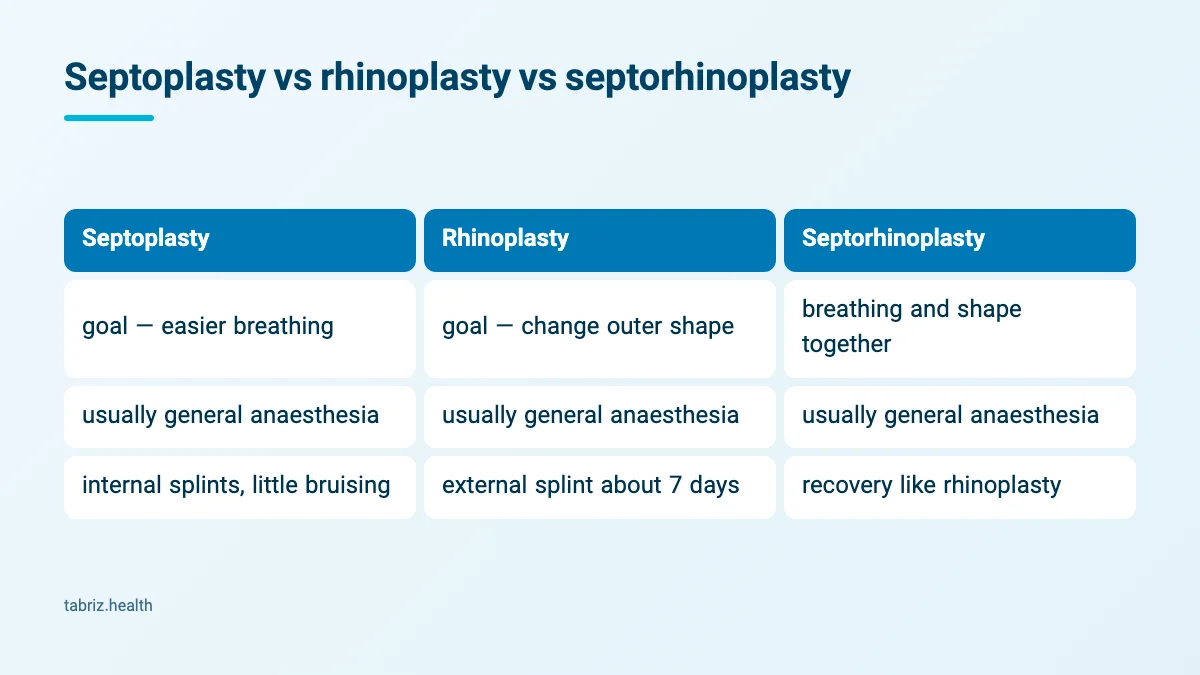
| Septoplasty | Rhinoplasty | Septorhinoplasty | |
|---|---|---|---|
| Main goal | Better breathing by straightening the septum | Changing the outer shape of the nose | Breathing and shape together |
| Where the work is done | Inside the nose, usually through the nostrils | Nasal bones, cartilage and tip | Inside and outside |
| Typical anaesthesia | Usually general; local may be an option | Usually general | Usually general |
| Changes appearance? | Not on its own | Yes | Yes |
| Typical early recovery | Internal splints or packing; little or no visible bruising | External splint for about a week; bruising around the eyes | Similar to rhinoplasty |
Septoplasty
The surgeon lifts the lining that covers the septum, then trims, straightens or repositions the bent cartilage and bone. Sometimes the turbinates (structures on the side walls of the nose) are reduced at the same time to improve airflow. Because the work is done through the nostrils, ENT Health notes there is usually no outward sign of surgery. Cleveland Clinic gives a typical operating time of 30 to 90 minutes, and most people go home the same day.
Rhinoplasty
Rhinoplasty changes the outside of the nose: for example the bridge, a hump, the width or the tip. NHS information describes it as usually done under general anaesthetic, taking about 1.5 to 3 hours, with a splint taped over the nose for about 7 days. For the cosmetic side, techniques and choosing a surgeon, see our rhinoplasty treatment guide.
Septorhinoplasty and "functional rhinoplasty"
Septorhinoplasty treats the septum and the outer nose in one operation. "Functional rhinoplasty" is a broader term surgeons use when the aim of reshaping is to improve breathing. One example is the nasal valve, the narrowest part of the airway: Cleveland Clinic notes that most people with nasal valve collapse also have a deviated septum, and treatment can include cartilage grafts to support the valve as well as septoplasty.
Who needs which operation
In general terms:
- Septoplasty may be suggested when a clearly deviated septum causes real symptoms, such as a blocked nose, and these have not settled with medical treatment.
- Rhinoplasty may suit people who are unhappy with the appearance of their nose and breathe well.
- Septorhinoplasty may be suggested when there is both a breathing problem and a shape concern, or when the outer structure is part of the breathing problem.
Evidence supports septoplasty for the right patients. A randomised trial of 203 adults in the Netherlands, published in The Lancet in 2019 and summarised by the UK's NIHR, found that septoplasty improved quality of life and nasal airflow more than non-surgical care, with the benefit still present at two years. The benefit was less clear in people with only mild deviation. Children are usually not offered septoplasty unless the problem is severe, because the nose is still growing.
How doctors assess a deviated septum
Assessment usually starts with your symptoms and a look inside the nose. Cleveland Clinic describes an examination with a nasal speculum, a small tool that holds the nostrils open. If more detail is needed, a doctor may use nasal endoscopy (a thin camera) or a CT scan to look deeper inside the nose and sinuses. Not everyone needs a scan. If you are travelling, send previous scans, ENT reports and clear photos before your trip.
Before surgery, it helps to have tried medical treatment. Antihistamines, steroid nasal sprays and decongestants can ease symptoms, but Cleveland Clinic points out that they do not change the septum. Decongestant sprays should not be used for more than three days in a row, because they can cause rebound congestion.
Recovery: how septoplasty and rhinoplasty differ
After septoplasty
Cleveland Clinic and the American Society of Plastic Surgeons (ASPS) describe soft packing, internal splints or dissolving stitches to hold the septum in place. Packing may come out a day or two after surgery, and splints that have not dissolved are usually removed at a follow-up visit about a week later. Initial recovery takes about one to two weeks, and full healing of the bone and cartilage takes several months. Cleveland Clinic suggests light activity such as walking after about a week and strenuous exercise after about a month.
Common advice: no nose blowing for one to two weeks, sneeze with your mouth open and sleep with your head raised.
After rhinoplasty or septorhinoplasty
Expect more visible healing. NHS information says bruising and swelling around the eyes can last about 3 weeks, you may need up to 2 weeks off work, and strenuous exercise can usually restart at 4 to 6 weeks. ASPS notes that the final shape of the nose can take up to a year to refine, and that swelling may come and go during the first year. Our revision rhinoplasty guide explains why patience matters before judging the result.
Risks to discuss with your surgeon
Cleveland Clinic and ENT Health list these possible risks of septoplasty:
- bleeding and infection
- a hole in the septum (septal perforation) or a collection of blood in the septum (septal haematoma)
- numbness of the nose or upper teeth, usually temporary
- a reduced sense of smell
- a change in the outer shape of the nose
- rare problems such as a spinal fluid leak or toxic shock syndrome
Rhinoplasty adds risks linked to shape, such as asymmetry or a result you do not like, and NHS information also lists breathing difficulty. In the Lancet trial above, 18% of people who had surgery had complications, mostly mild.
Get medical help promptly for heavy bleeding that will not stop, a high fever, worsening pain, a severe headache, a stiff neck or trouble breathing.
Medical need vs cosmetic choice
Health systems and insurers often treat these operations differently. ASPS lists septoplasty as a reconstructive procedure and rhinoplasty as a cosmetic one. The NHS, for example, says rhinoplasty is usually not available for cosmetic reasons but may be provided if it is needed to help you breathe. When the operation is combined, the breathing part and the cosmetic part may be judged separately. If you have health insurance at home, ask your insurer directly what it covers before you plan anything, and ask the treating center for a written report of the diagnosis.
For indicative prices of septorhinoplasty and other nose surgery, see our rhinoplasty in Iran cost guide.
How long to stay in Tabriz
Your surgeon sets the plan, but in general:
- Septoplasty alone: usually a same-day operation, with a check-up to remove splints about a week later. Planning to stay about a week covers that visit, unless your surgeon advises otherwise.
- Rhinoplasty or septorhinoplasty: the external splint usually stays for about 7 days, so a stay of about 7 to 10 days is common advice.
Add days for the first consultation and tests, and keep your return ticket flexible. Ask your surgeon when it is safe for you to fly. Our Iran medical visa guide and guide to hospitals in Tabriz help with planning.
Next steps
If your nose feels blocked, start with an ENT assessment of the cause. If you also want a change in shape, say so at the start, so the surgeon can plan one operation rather than two. Tabriz Health coordinators can help you contact licensed centers in Tabriz, share your scans and photos, compare surgeons' replies and plan travel. You can request a free consultation to get started.
Frequently asked questions
Does septoplasty change the shape of my nose?
Not on its own. Septoplasty works inside the nose, although a change in the outer shape is listed among its possible complications. If you want a different shape, that is rhinoplasty, which can be done at the same time.
Can septoplasty and rhinoplasty be done together?
Yes. This is called septorhinoplasty. It means one anaesthetic and one recovery, but recovery is closer to that of a rhinoplasty.
Is septoplasty painful?
ASPS describes minor pain and some difficulty breathing during early healing. Your surgeon will advise which pain relief to use, since medicines such as aspirin or ibuprofen may thin the blood.
How soon will my breathing improve?
The nose often feels blocked at first because of swelling and splints. ASPS notes that initial swelling settles within a few weeks and the full benefit may take a few months.
This article is general information, not medical advice. Your surgeon decides which operation, if any, is suitable for you. Read our medical disclaimer and editorial policy.
Müalicə bələdçiləri
Müəllif haqqında
Tabriz Health redaksiya komandası
The Tabriz Health editorial team writes patient guides from reliable sources. Articles are checked for scientific accuracy before publication; they are general information, not medical advice.