
All-on-4 Dental Implants: How Full-Arch Fixed Teeth Work
How All-on-4 dental implants work, tilted back implants, the temporary and final bridge, who is a candidate, All-on-4 vs All-on-6 and overdentures, and planning two trips to Tabriz.
Tabriz Health redaksiya komandası
All-on-4 dental implants are a way to give a whole jaw a fixed set of teeth using only four implants. You may have seen it advertised as "teeth in a day". In reality there is usually a temporary bridge first, a final bridge later, and lifelong cleaning and check-ups.
This guide explains how All-on-4 works, who may be a candidate, how it compares with other options and how travelling patients plan their trips to Tabriz. For implant basics and the general treatment page, see our dental implant treatment guide. Tabriz Health is a facilitation platform, not a clinic; only a dentist who examines you and your scans can say what suits you.
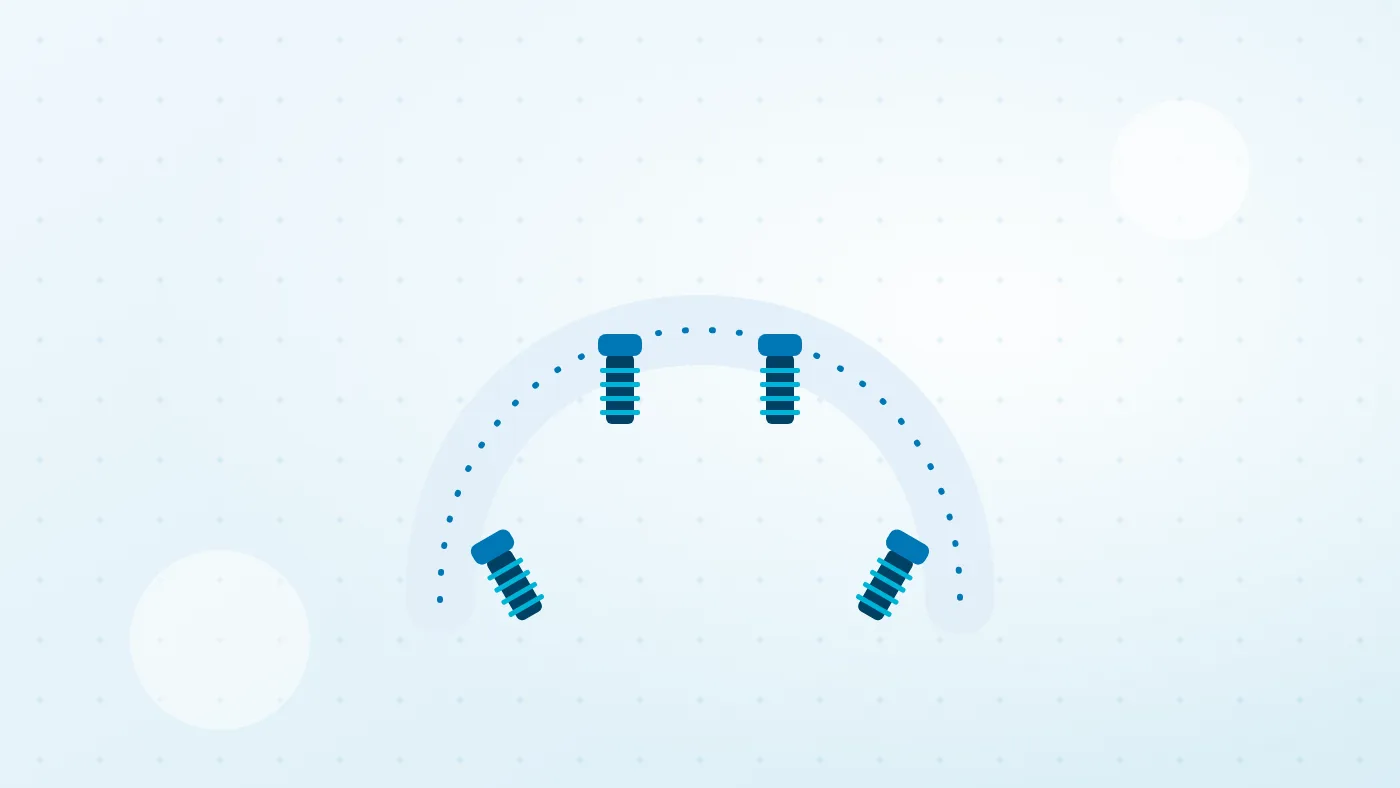
- All-on-4 fixes a full-arch bridge on four implants: two upright at the front and two tilted at the back.
- Tilting the back implants is meant to use the available bone and often avoid a sinus lift or bone graft.
- A temporary fixed bridge may be fitted soon after surgery if the implants are stable enough; the final bridge comes months later.
- Smoking, untreated gum disease, unmanaged diabetes and severe bone loss can rule you out or raise the risks.
- Most travelling patients plan two trips, with healing at home in between.
- A full-arch bridge needs careful daily cleaning and regular professional maintenance for life.
What All-on-4 dental implants are
"All-on-4" is the name for a treatment concept first described by the dentist Maló in 2003. Four implants are placed in one jaw (upper or lower), and a single fixed bridge carrying a full row of teeth is screwed onto them. You do not take this bridge out at home; it stays in like natural teeth. A dentist can remove it at maintenance visits.
It is one type of full-arch implant treatment. Cleveland Clinic describes full-arch treatment in general as roughly four to six implants supporting a full set of upper or lower teeth, either as a fixed bridge or as a denture that snaps on and off.
Why the back implants are tilted
In the classic All-on-4 layout, the two front implants are placed upright (axially) and the two back implants are placed at an angle. After teeth are lost, the jawbone often shrinks, and the sinus (upper jaw) or a nerve (lower jaw) limits where implants can go. Angling the back implants lets the dentist use bone that is still there and spread the implants further apart, which reviews describe as an alternative to sinus lift or bone augmentation for many patients.
A 2021 systematic review found no significant difference in survival between tilted and upright implants in All-on-4 treatment.
All-on-4 vs individual implants, All-on-6 and overdentures
All-on-4 is not the only way to replace a full arch. The right option depends on your bone, bite, health and how easily you can clean.
| Option | How it works | Points to discuss with your dentist |
|---|---|---|
| All-on-4 | Fixed full-arch bridge on four implants, back two tilted | Often avoids grafting; needs enough bone in the front of the jaw |
| All-on-6 (or more implants) | Fixed full-arch bridge on five, six or more implants | Needs more bone; a 2026 review found survival comparable to All-on-4 |
| Individual implants and implant bridges | Separate crowns or short bridges on many implants | More implants and usually more bone; may involve grafting |
| Implant overdenture | Denture that clicks onto implants and is removed for cleaning | Easier to clean; less firm than a fixed bridge |
All-on-4 or All-on-6
A 2026 systematic review compared All-on-4 with fixed full-arch treatment on more than four implants and found comparable implant and bridge survival and no significant differences in complication rates. The number of implants is a planning decision based on your scan.
Fixed bridge or overdenture
One comparison on four implants found a trade-off. In a small crossover study in the lower jaw, patients rated the fixed bridge higher for retention and stability, and the bar-retained overdenture higher for comfort and ease of cleaning. If you find cleaning hard, ask about an overdenture.
When bone is very thin
If the upper jaw has lost a lot of bone, a dentist may discuss bone grafting first, or zygomatic implants, which are longer implants anchored in the cheekbone. Reviews describe them as a graft-free option for selected patients, with sinus and gum-tissue problems among reported complications.
Who may be a candidate
All-on-4 is aimed at people who have lost all the teeth in a jaw, or whose remaining teeth are failing. Reviews describe it as an option for patients with a shrunken jaw who prefer not to have bone-regeneration procedures. Only an exam and a 3D scan (CBCT) can confirm it.
Cleveland Clinic lists situations where implants may not be ideal: active or untreated gum disease, severe jawbone loss, unmanaged diabetes, some bone and autoimmune conditions, extensive decay and poor oral hygiene. It also notes that smoking or vaping can disrupt healing. A 10-year All-on-4 study found that smoking significantly affected implant failure.
Same-day teeth: the temporary bridge and the final bridge
All-on-4 is often marketed as "teeth in a day". What usually happens is immediate loading: a temporary fixed bridge is attached soon after the implants are placed. A 2026 review noted that immediate loading may improve satisfaction and shorten treatment, but only when the implants have adequate primary stability, meaning they are held firmly by the bone on the day. If they are not, the dentist may wait before fixing teeth to them.
The bone then needs time to bond to the implants. Cleveland Clinic describes this bonding (osseointegration) as taking anywhere from three to nine months. After that, the dentist takes new records and fits the final bridge. Be cautious of offers that promise final teeth in one short stay without a full exam.
Planning your trips to Tabriz
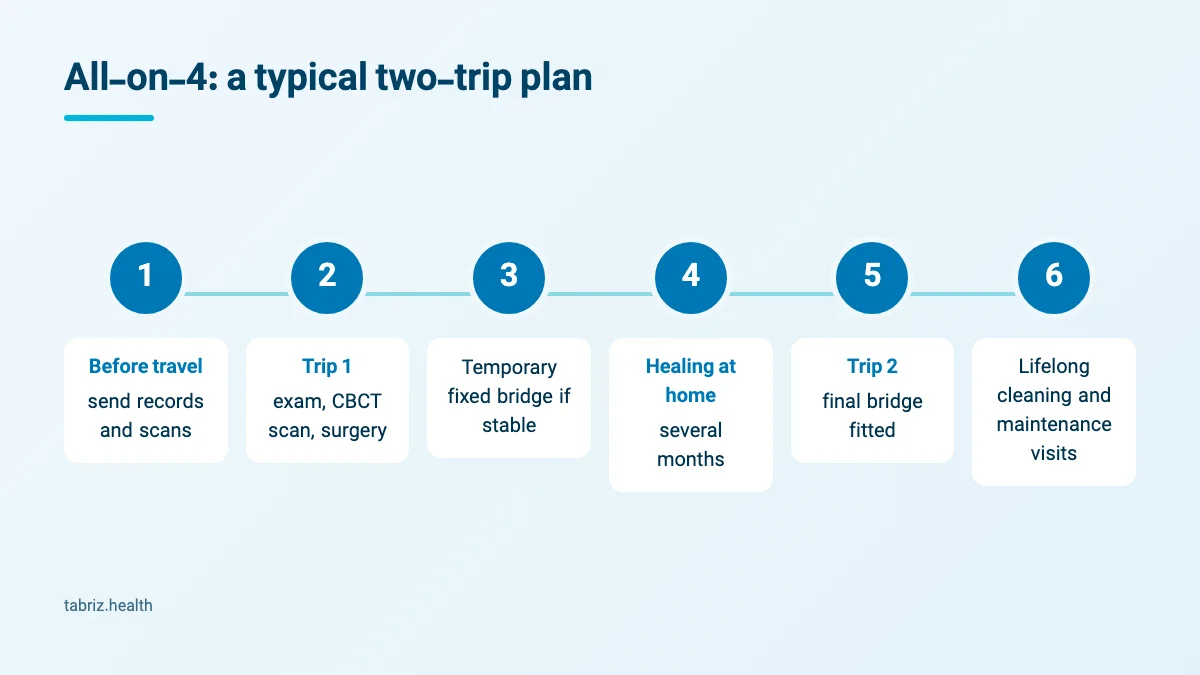
Because the final bridge comes after healing, most patients travelling for All-on-4 plan two trips.
- Before you travel: send photos, any X-rays or scans and your medical history through a free consultation request. Any plan at this stage is provisional.
- Trip 1: exam, CBCT scan, final planning, extractions if needed, implant surgery and, where suitable, a temporary fixed bridge.
- Healing at home: several months on the temporary bridge, ideally with a local dentist checking you.
- Trip 2: checks, new impressions or scans, try-in and fitting of the final bridge.
Check the visa steps for both trips; our Iran medical visa guide explains the general process. If both jaws need treatment, or grafting is needed, the plan can be longer. For indicative prices and what changes a quote, read our dental implant cost in Iran article; we do not repeat prices here.
Living with an All-on-4 bridge: care and maintenance
A full-arch bridge does not decay, but the gums and bone around the implants can become inflamed. A 2026 analysis of the maintenance phase described three groups of problems: gum and bone problems around implants (peri-implant mucositis, peri-implantitis and bone loss), hygiene problems where the bridge shape makes cleaning hard, and wear-and-tear problems such as screw loosening, screw fracture and material wear.
- Clean under and around the bridge every day with the brushes your dentist shows you; special implant brushes and similar aids exist for this.
- Keep regular maintenance visits. At some visits the dentist may unscrew the bridge to clean and check the implants.
- Report a loose bridge, chipped tooth or bleeding gums early.
Arrange a dentist at home before you travel and take copies of your scans and implant details.
Risks and complications
All-on-4 is surgery, and reviews describe it as a predictable option but not a risk-free one. Possible problems include:
- infection or delayed healing after surgery;
- an implant not bonding with the bone, which may mean removing it and changing the plan;
- fracture of the bridge; a 2021 review found that fracture of the acrylic bridge was the main prosthetic complication, and a 2026 review found lower fracture rates for metal-ceramic than for metal-acrylic bridges;
- inflammation and bone loss around implants over time;
- screw loosening or breakage.
Reviewers note that much of the evidence is retrospective with limited follow-up. Contact your dentist quickly if pain or swelling gets worse instead of better, or if you have fever, pus, bleeding that does not stop, numbness that does not fade, or a bridge that feels loose.
Questions to ask before you choose a center
- Is All-on-4 right for me, or would more implants, grafting or an overdenture be better, and why?
- Will I get a temporary fixed bridge, and what happens if the implants are not stable enough on the day?
- What material will the final bridge be made of, and what is the repair plan if it chips or breaks?
Tabriz Health coordinators can help you contact licensed dental centers, ask these questions and compare written plans. Some patients need other dentistry in Tabriz first, such as gum treatment.
Next steps
Gather any dental X-rays, scans and your medical history, then send them through a free consultation request. Our coordinators can share your records with licensed centers in Tabriz and help you plan both trips. The final plan is always confirmed after the exam and CBCT scan.
Frequently asked questions
Can I get All-on-4 in one trip?
You can often leave the first trip with a temporary fixed bridge, if the implants are stable enough. The final bridge is usually made after the bone has healed, which normally means a second trip months later.
Can smokers have All-on-4?
Smoking can disrupt healing, and a long-term All-on-4 study found it significantly affected implant failure. Your dentist may ask you to stop; discuss it honestly before surgery.
Can I take the All-on-4 bridge out myself?
No. It is screwed to the implants and only a dentist removes it. If you want teeth you can take out to clean, ask about an implant overdenture.
What does All-on-4 cost in Iran?
This article does not list prices. See our dental implant cost guide for indicative ranges and what changes a quote.
This article is general information, not medical advice. Your dentist decides what is right for you after examining you. Read our medical disclaimer and editorial policy.
Müalicə bələdçiləri
Müəllif haqqında
Tabriz Health redaksiya komandası
The Tabriz Health editorial team writes patient guides from reliable sources. Articles are checked for scientific accuracy before publication; they are general information, not medical advice.